Projects / Physics
Electron-phonon coupling in TiH₂
First-principles study of whether the metal hydride TiH₂ could be an electron-phonon superconductor.
Density functional theoryPhonons
The discovery of a superconducting transition temperature of K in metallic H₂S under pressures of 200 GPa renewed interest in the superconducting properties of metal-hydrogen systems. These materials are expected to be electron-phonon superconductors, and hydrogen, with its low mass, contributes new optic phonons that may couple with the conduction electrons. Often, though not always, a large electron-phonon coupling parameter (and consequently a high ) results from a high electronic density of states at the Fermi level, , and the presence of soft phonons.
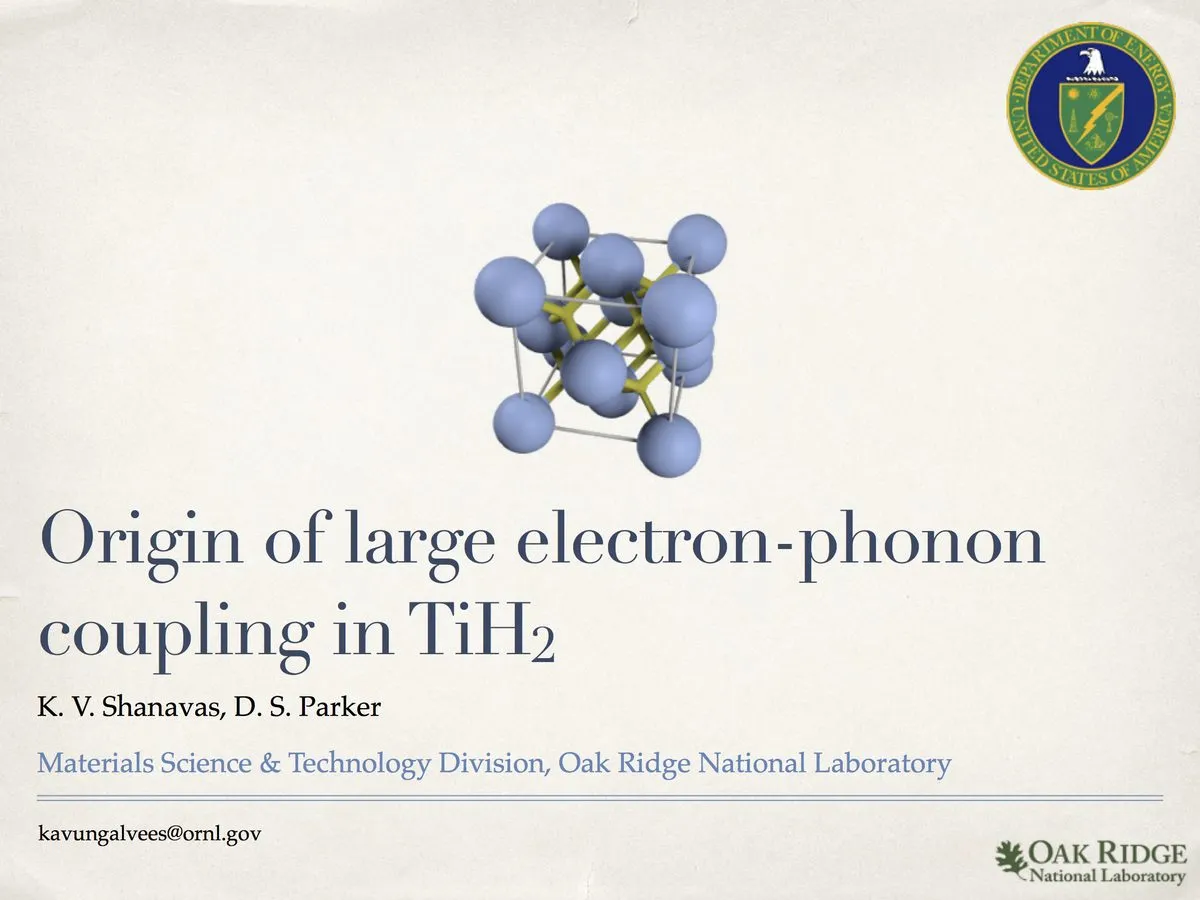
Our first-principles calculations of cubic TiH₂ show a large 3d density of states, states/eV/f.u. The calculated phonon dispersions show Ti modes active below 10 THz, whereas the much lighter H modes are active between 32 and 40 THz. Electron-phonon coupling calculations give , which corresponds to K. However, the large also leads to a tetragonal instability at low temperatures, which may be overcome by uniaxial strain, potentially making TiH₂ a candidate electron-phonon superconductor.
Related papers
- Electronic structure and electron-phonon coupling in TiH2Sci. Rep. 6, 28102 (2016) · DOI