Projects / Physics
The Rashba effect
How electric fields at oxide surfaces split electron spin bands, and how to tune that splitting.
Density functional theoryTight-binding modelsPerturbation theory
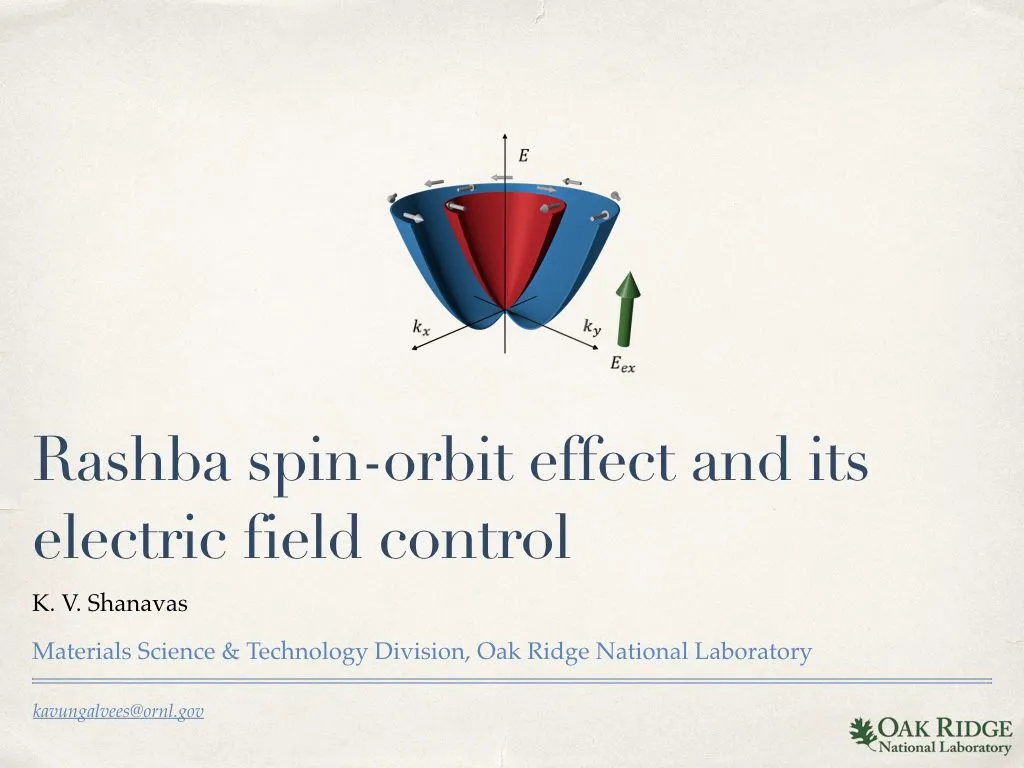
The Rashba effect, or Rashba-Dresselhaus effect, is a momentum-dependent splitting of spin bands in two-dimensional condensed matter systems. Consider a particle with charge and spin moving with velocity through an electric field . It feels a magnetic field
The spin of the particle couples to this field through the Hamiltonian
which can be rewritten in the Rashba form .
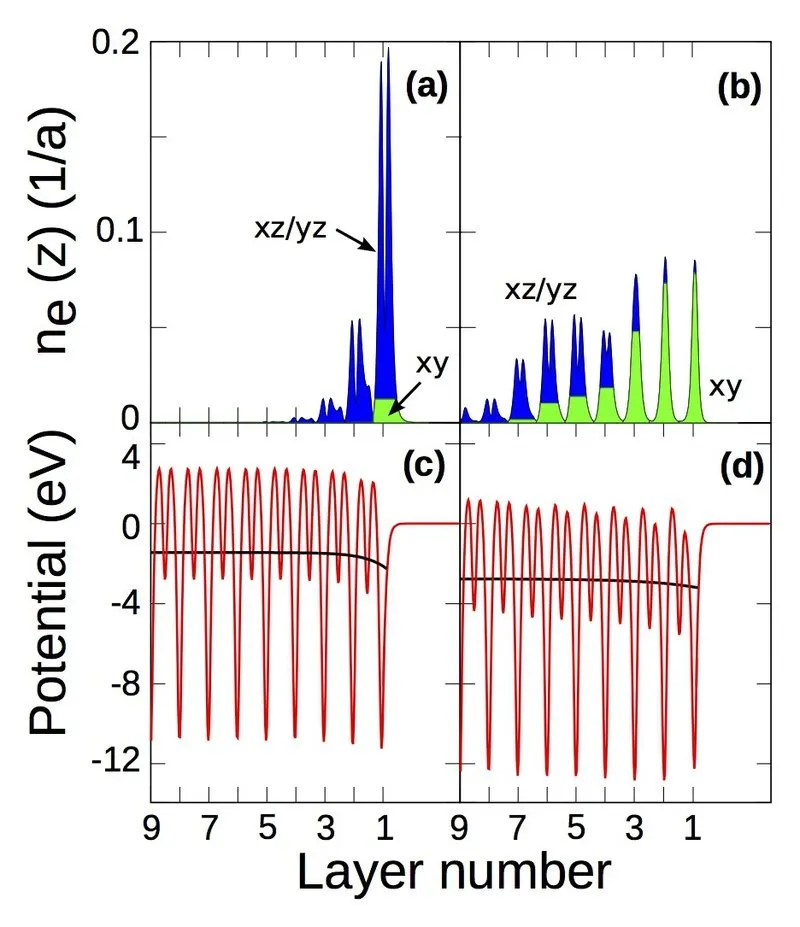
2DEG on a polar surface. The 2D electron gas density (top) and the local potential (bottom) for a slab of KTaO₃ in the unrelaxed (left) and relaxed (right) structures, from density functional theory. The TaO₂ layers are numbered on the x axis, with the surface layer marked 1. Structural relaxation substantially weakens the surface potential.
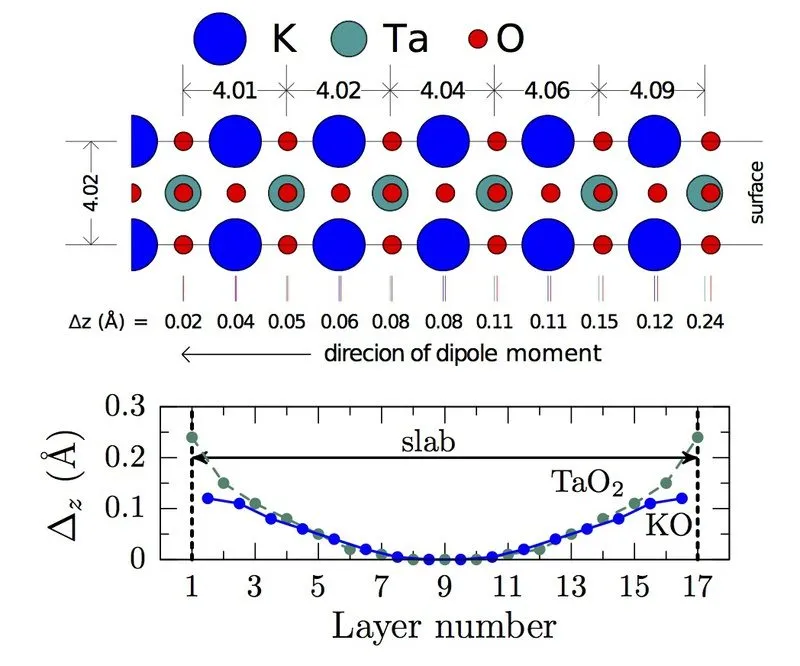
Structural relaxation. The relaxed structure of the KTaO₃ slab in the first six layers near the surface, beyond which there is no significant distortion. The lower panel shows the change of the cation-anion distance Δz in each layer due to relaxation, with layers 1 and 17 being the two surface Ta layers.
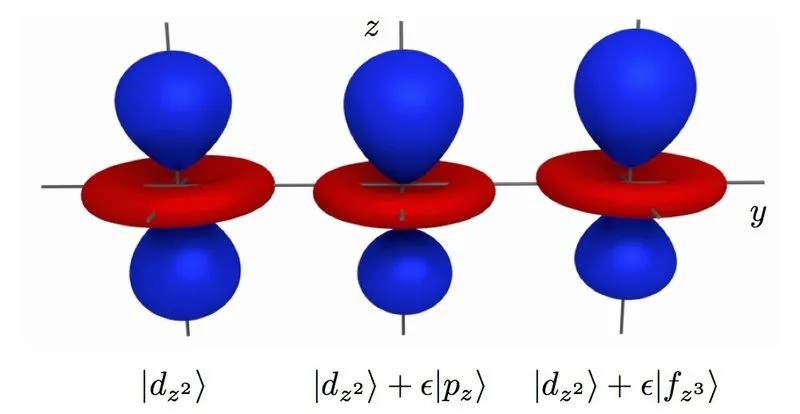
Perturbed orbitals. Contour plot of the orbital showing the effect of electric-field induced mixing with the and orbitals at ε = 0.3. Colours distinguish the signs of the wave function.
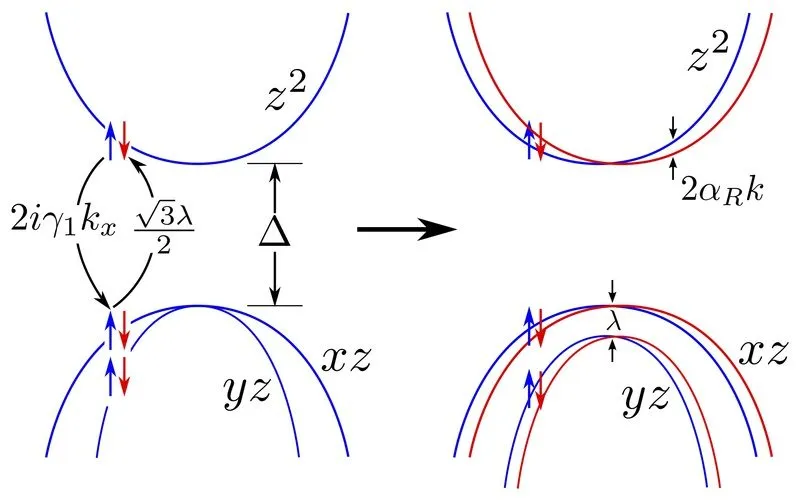
Perturbation theory. Rashba spin splitting through second-order perturbation theory. The bands on the left are spin degenerate. The band interacts with through the electric field (), while the band interacts with through spin-orbit coupling (). Together they split the up and down bands, as shown on the right.